
The Canon EOS 40D, released in 2008, represents a significant step for enthusiasts, blending advanced features with user-friendly controls for exceptional photographic results.
This DSLR offers a robust build, a 10.1-megapixel sensor, and a versatile autofocus system, making it suitable for diverse shooting scenarios and skill levels.
Understanding date formats (mm/dd/yyyy vs dd/mm/yyyy) and terms like ‘anniversary’ are crucial when reviewing shooting dates and event logging.
Overview of the Camera
The Canon EOS 40D is a 10.1-megapixel digital SLR camera designed for both amateur and semi-professional photographers. Released in March 2008, it quickly became popular due to its balance of features and affordability. The camera body is constructed with a durable magnesium alloy, offering a solid feel and weather resistance.
Key aspects include a 3.0-inch LCD screen, a 9-point autofocus system, and continuous shooting at up to 6.5 frames per second. Remembering dates, like its release, and understanding terms like ‘salutation’ (letter beginnings) are unrelated but demonstrate attention to detail.
Key Features and Specifications
The Canon EOS 40D boasts a 10.1-megapixel APS-C CMOS sensor, delivering high-resolution images. It features a DIGIC 3 image processor for fast performance and excellent image quality. The camera offers ISO settings from 100 to 3200 (expandable to 6400). Its 9-point autofocus system ensures sharp focus, while continuous shooting reaches 6.5 fps.
Other notable specs include a 3.0-inch LCD, Live View shooting, and compatibility with EF and EF-S lenses. Considering date formats (mm/dd/yyyy) is irrelevant here, focusing solely on the camera’s technical capabilities.
Understanding the Camera Body
The Canon EOS 40D’s body is designed for comfortable handling and durability, featuring a robust construction and intuitive layout of controls for easy access.
Front Panel Controls
The Canon EOS 40D’s front panel houses essential controls for immediate access during shooting. You’ll find the lens release button, enabling quick lens changes, and the depth-of-field preview button, allowing visualization of aperture effects.
The autofocus point selection/AF area mode button is crucial for precise focusing, while the metering mode selector lets you choose the appropriate light measurement setting. A programmable custom function button offers personalized control. Understanding these controls, alongside date/time settings, enhances operational efficiency.
Rear Panel Controls
The Canon EOS 40D’s rear panel is densely populated with controls for comprehensive camera operation. The prominent LCD screen displays shooting information and facilitates menu navigation. The directional buttons and SET button allow efficient menu adjustments, including date and time settings.
Dedicated buttons provide quick access to features like white balance, picture style, and Live View. The AE-L/AF-L button enables locking of exposure and focus, while the playback button reviews captured images. Mastering these controls is key to unlocking the camera’s potential.
Top Panel Controls
The Canon EOS 40D’s top panel houses essential controls for immediate shooting adjustments. The main dial selects shooting modes – Automatic, Program AE, Shutter Priority, Aperture Priority, and Manual. The shutter button initiates image capture, and the control dial adjusts settings within the selected mode.
A dedicated button activates the built-in flash, and the mode dial allows quick switching between various shooting scenarios. Understanding these controls enables photographers to respond swiftly to changing conditions and capture the perfect moment, referencing accurate dates.
Button and Dial Functions
The Canon EOS 40D utilizes a combination of buttons and dials for intuitive operation. The main dial, alongside the Quick Control dial, facilitates swift adjustments to aperture, shutter speed, and exposure compensation. Dedicated buttons provide direct access to ISO, white balance, and drive mode settings.
The AF point selection button allows precise focus control, while the menu button unlocks customization options. Remembering these functions, alongside accurate date/time settings, streamlines workflow and enhances creative control during shooting sessions.
Menu System Navigation
The Canon EOS 40D’s menu system is logically structured, offering customization of settings like date, time, and picture styles. Efficient navigation is key to unlocking its full potential.
Menu Structure Overview
The Canon EOS 40D’s menu is divided into several tabs, each addressing a specific category of settings. These include shooting, AF, quality, picture style, and setup. Within each tab, options are logically grouped for easier access.
Navigating utilizes the directional buttons and SET button. Understanding this structure, and remembering that settings impact image quality, is vital. Date and time adjustments reside within the setup menu, alongside options for file naming and formatting.
The menu’s clarity allows for efficient customization, enabling photographers to tailor the camera to their preferences and shooting conditions.
Customization Options
The Canon EOS 40D offers extensive customization. Users can tailor autofocus behavior, image quality parameters, and button functions to suit their shooting style. Custom Functions allow assigning specific operations to buttons, streamlining workflow.
Picture Styles enable personalized color rendition, while menu display preferences can be adjusted for clarity. Remembering date formats (mm/dd/yyyy or dd/mm/yyyy) is useful when setting file naming conventions.
These options empower photographers to optimize the camera for diverse scenarios and achieve desired results.
Setting the Date and Time
Accurate date and time settings are crucial for proper file naming and organization within the Canon EOS 40D. Access the date/time setting through the camera’s menu system. Be mindful of regional date format preferences – mm/dd/yyyy or dd/mm/yyyy – to avoid confusion.
Incorrect settings can lead to chronological errors when reviewing images. Understanding terms like ‘anniversary’ highlights the importance of correct date recording. Ensure synchronization with a reliable time source for precise metadata.
Shooting Modes Explained
The Canon EOS 40D offers diverse shooting modes, from fully automatic options for beginners to manual control for experienced photographers, enabling creative flexibility.
Automatic Shooting Modes
The Canon EOS 40D simplifies photography with several automatic modes. The ‘P’ (Program AE) mode allows the camera to select aperture and shutter speed, while you maintain control over ISO and white balance. Scene modes, like Portrait, Landscape, and Sports, optimize settings for specific subjects.
These modes are ideal for beginners or situations demanding quick results. Remembering date formats (mm/dd/yyyy or dd/mm/yyyy) is useful when reviewing photos taken in automatic mode, as the camera records the shooting date. Understanding ‘as of’ versus ‘as at’ doesn’t directly apply here, but precise timing is always valuable.
Program AE (P) Mode
In Program AE (P) mode on the Canon EOS 40D, the camera automatically sets both aperture and shutter speed, striving for proper exposure. However, you retain control over crucial settings like ISO sensitivity, white balance, and exposure compensation. This offers a balance between automation and creative input.
It’s useful for quickly adapting to changing light. Remembering the shooting date (like 01/27/2026) is helpful for organization. Unlike a strict ‘birthday’ or ‘anniversary’, P mode is flexible. Salutations and closings aren’t relevant, but thoughtful settings are!
Shutter Priority (Tv) Mode
Shutter Priority (Tv) mode on the Canon EOS 40D allows you to dictate the shutter speed, while the camera automatically adjusts the aperture for correct exposure. This is ideal for controlling motion – freezing action with fast speeds or blurring movement with slower ones.
Consider the date (mm/dd/yyyy) when reviewing action shots. Unlike a fixed ‘birthday’, Tv mode is dynamic. ‘As of’ a certain shutter speed, you control the image. Remember, midnight on a date is ambiguous, so note the time!
Aperture Priority (Av) Mode
Aperture Priority (Av) mode on the Canon EOS 40D lets you select the aperture (f-stop), controlling depth of field, while the camera sets the shutter speed. A wider aperture (lower f-number) creates shallow depth of field, ideal for portraits. A narrower aperture (higher f-number) maximizes depth of field for landscapes.
Like noting a ‘death anniversary’, precise aperture settings are vital. ‘As at’ a specific f-stop, you shape the image. Be mindful of date formats (dd/mm/yyyy) when reviewing images, and use ‘salutation’ to label your settings.
Manual (M) Mode
Manual (M) mode grants complete control over both aperture and shutter speed on your Canon EOS 40D. This mode is ideal for challenging lighting conditions or when precise exposure is critical. You determine both settings, allowing for creative control beyond automatic modes.
Remembering the ‘birthday’ of your settings – the exact combination – is key. Like noting a date ‘as of’ a specific moment, record your choices. Understanding the difference between ‘as at’ and ‘as of’ helps track adjustments.
Focusing System
The Canon EOS 40D features a 9-point autofocus system, offering various modes for static or moving subjects. Precise focus point selection is crucial for sharp images.
Autofocus Modes
The Canon EOS 40D provides several autofocus (AF) modes to suit different shooting conditions. One-Shot AF is ideal for stationary subjects, locking focus when the shutter button is half-pressed. AI Servo AF continuously tracks moving subjects, adjusting focus as they change position – perfect for sports or wildlife.
AI Focus AF intelligently switches between One-Shot and AI Servo, attempting to determine subject movement. Manual focusing is also available for precise control, especially in low light or challenging situations. Understanding these modes ensures optimal image sharpness and clarity, adapting to diverse photographic needs.
Focus Point Selection
The Canon EOS 40D features a 9-point autofocus system, allowing for precise focus point selection. You can choose a single focus point for pinpoint accuracy, or utilize automatic selection for the camera to determine the best focus area. Expanding the AF point area can aid in tracking moving subjects, increasing the chances of a sharp image.
Selecting the appropriate focus point is crucial for achieving desired results, especially when composing shots with specific subjects. Remember that focusing on a specific date, like a birthday, requires precision!
Manual Focusing
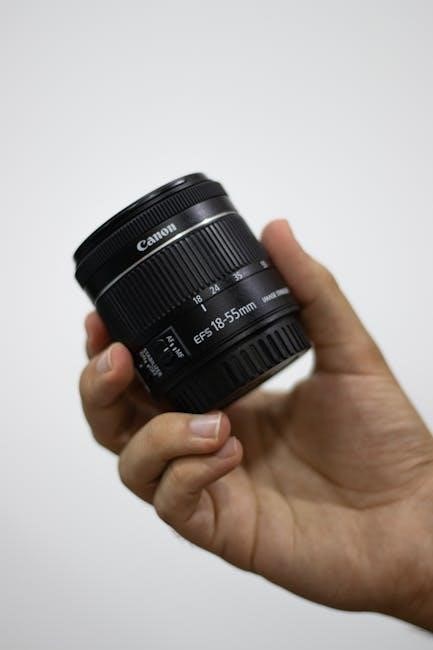
The Canon EOS 40D allows for precise manual focusing by switching the autofocus/manual focus selector on the lens. Rotate the focusing ring on the lens to achieve sharp focus, utilizing the viewfinder or Live View for assistance. Zooming in on the image in Live View provides enhanced accuracy.
Manual focus is particularly useful in low-light situations or when autofocus struggles. Remembering specific dates, like anniversaries, requires a focused approach, much like achieving sharp manual focus!
Image Quality Settings
The Canon EOS 40D offers choices between RAW and JPEG formats, impacting editing flexibility and file size. Adjust image size and compression levels for desired quality.
RAW vs. JPEG
Choosing between RAW and JPEG on the Canon EOS 40D fundamentally alters your post-processing capabilities. JPEG files are compressed, resulting in smaller file sizes ready for immediate use, but with some data loss. This makes them ideal for quick sharing or when storage space is limited.
RAW files, conversely, contain all image data captured by the sensor, offering maximum flexibility for editing white balance, exposure, and other parameters without degradation. However, RAW files are significantly larger and require dedicated software for processing before they can be viewed or printed. Consider your workflow and editing needs when selecting a format.
Image Size and Compression
The Canon EOS 40D allows you to customize image size and compression levels to balance image quality and storage capacity. Larger image sizes (e.g., 10.1MP) capture more detail, suitable for large prints or extensive cropping, but demand more memory card space.
Compression settings – Fine, Normal, and Low – affect file size; Fine offers the highest quality with minimal compression, while Low provides the smallest files with noticeable quality reduction; Understanding these options is vital for efficient workflow, especially when considering date-based organization.
White Balance Settings
The Canon EOS 40D offers a range of White Balance (WB) settings to ensure accurate color reproduction under various lighting conditions. Presets include Auto, Daylight, Cloudy, Tungsten, Fluorescent, and Flash, each optimized for specific light sources.
Custom WB allows manual calibration using a white or gray card for precise color accuracy. Incorrect WB can result in color casts (e.g., bluish or yellowish tones). Remembering the date and time of shooting aids in post-processing WB adjustments if Auto WB fails.
Using the Flash
The Canon EOS 40D features a built-in flash with various modes, alongside compatibility with external flash units for enhanced control and creative lighting options.
Built-in Flash Features
The Canon EOS 40D’s integrated flash offers several functionalities to enhance your photography. Auto mode intelligently determines flash firing, while Red-Eye Reduction minimizes the effect. Flash Exposure Compensation allows fine-tuning of flash intensity, and you can choose between First-Curtain and Second-Curtain sync.
Furthermore, the flash can be set to High-Speed Sync for use with faster shutter speeds, overcoming limitations in bright conditions. Understanding these features, alongside date/time settings, ensures accurate event logging and optimal image capture. Remember to consider the ambiguity around midnight dates!
External Flash Compatibility
The Canon EOS 40D readily supports Canon’s EX-series Speedlites, offering extensive control via the camera’s menu system. This includes wireless flash control, enabling off-camera flash setups for creative lighting. TTL (Through-The-Lens) metering ensures accurate exposures, while manual flash control provides full creative command.
Compatibility extends to various flash modes and features. Remembering proper date formatting (mm/dd/yyyy or dd/mm/yyyy) is vital when reviewing flash-related settings logs. Utilizing salutations and closings in notes about flash setups adds professionalism.
Flash Exposure Compensation
Flash Exposure Compensation (FEC) on the Canon EOS 40D allows precise adjustment of flash output, overriding the camera’s automatic metering. This is crucial for achieving correctly exposed images in challenging lighting conditions. FEC is adjusted in stops (+/-), offering granular control over flash intensity.
Understanding the concept of ‘as of’ versus ‘as at’ dates is irrelevant here, but accurate record-keeping of FEC settings is vital. Remembering anniversaries (like firmware update dates) aids troubleshooting. Proper FEC use ensures optimal image quality.
Advanced Features
The Canon EOS 40D boasts Picture Styles, Custom Functions, and Live View shooting, enhancing creative control and offering tailored photographic experiences for skilled users.
Picture Styles
Canon’s Picture Styles offer pre-defined tonal palettes, influencing image appearance directly within the camera. These include Standard, Portrait, Landscape, Neutral, Faithful, and Monochrome, each adjusting sharpness, contrast, color saturation, and tone.
Users can customize these presets or create and save their own unique styles, tailoring the camera’s output to their specific preferences. This allows for consistent results and reduces post-processing needs. Remembering dates, like the camera’s release, aids understanding its capabilities. Experimenting with Picture Styles unlocks creative potential, offering distinct looks without extensive editing.
Custom Functions
The Canon EOS 40D boasts an extensive array of Custom Functions, allowing photographers to personalize camera operation to suit their individual shooting styles. These functions modify button assignments, autofocus behavior, exposure settings, and more, enhancing workflow efficiency.
Accessing these through the menu system enables fine-tuning of the camera’s response. Remembering specific dates, like firmware update releases, can be vital. Customization ensures the camera adapts to you, not the other way around, maximizing control and creative expression.
Live View Shooting
The Canon EOS 40D’s Live View mode allows composing and reviewing images on the LCD screen, offering a different perspective than the optical viewfinder. While beneficial for precise composition and video recording preparation, it’s important to note potential limitations in autofocus speed compared to traditional viewfinder shooting.
Understanding the date of firmware updates impacting Live View performance is helpful. Careful consideration of shooting conditions and subject movement is crucial when utilizing this feature, ensuring optimal image quality and focus accuracy.
Troubleshooting Common Issues
Addressing problems like error messages, battery failures, or image quality concerns is vital for continued use. Knowing the date of last maintenance helps!
Error Messages and Solutions
Encountering error messages on the Canon EOS 40D can be frustrating, but often have straightforward solutions. “Err 90” typically indicates a shutter curtain issue, requiring professional service. “Card Full” necessitates either deleting images or inserting a new memory card.
If you see an “Invalid File Format” error, ensure your card is formatted correctly. Understanding the date of the error’s first appearance can aid diagnosis. Refer to the camera’s manual for a comprehensive list of error codes and their corresponding remedies, prioritizing official Canon guidance.
Battery Problems
Canon EOS 40D battery issues often stem from improper charging or storage. If the camera fails to power on, first verify the battery is fully charged using the provided charger. Avoid extreme temperatures, as they can reduce battery life. A “Low Battery” warning indicates imminent shutdown; replace or recharge promptly.
If a battery isn’t recognized, check the contacts for corrosion. Note the date of the last successful charge to identify patterns. Consider a replacement battery if issues persist, ensuring it’s a genuine Canon product for optimal performance and safety.
Image Quality Concerns
Addressing image quality issues on the Canon EOS 40D begins with checking your settings. Ensure you’ve selected an appropriate image quality – RAW offers maximum flexibility, while JPEG provides smaller file sizes. Verify white balance is correctly set for the lighting conditions;
Soft or blurry images may indicate incorrect focusing or a slow shutter speed. Review shooting dates to correlate issues with specific conditions. Experiment with Picture Styles to fine-tune image appearance, and confirm your lens is clean and free of defects.

Maintenance and Care
Regular camera maintenance ensures longevity. Clean the sensor carefully, store the EOS 40D in a dry place, and periodically check for available firmware updates for optimal performance.
Cleaning the Sensor
Maintaining a clean sensor is vital for image quality. Dust accumulation impacts photos, appearing as spots. Use a blower to remove loose particles first; avoid touching the sensor directly. If needed, employ a sensor cleaning kit – swabs and fluid – following the manual’s instructions precisely.
Incorrect cleaning can damage the sensor. Lock up the mirror in cleaning mode (refer to the manual). Gently swipe the sensor once per pass, using a fresh swab for each direction. Always prioritize prevention by changing lenses in clean environments.
Storing the Camera
Proper storage safeguards your Canon EOS 40D. When not in use for extended periods, remove the battery to prevent potential corrosion from leakage. Store the camera in a cool, dry place, away from direct sunlight and extreme temperatures. A dedicated camera bag offers excellent protection against dust, moisture, and accidental impacts.
Consider using a desiccant pack inside the bag to absorb humidity. Avoid storing the camera with lenses attached for prolonged times, as this can strain the mount. Regular use is best!
Firmware Updates
Regular firmware updates enhance your Canon EOS 40D’s performance and compatibility. Check the Canon website periodically for available updates, as these often address bugs and introduce new features. Download the update file and follow Canon’s instructions carefully for installation – typically involving transferring the file to a memory card.
Ensure the camera has sufficient battery power during the update process to prevent interruption. A failed update can render the camera unusable, so proceed with caution and follow directions precisely.
Appendix
Essential resources include compatible memory card types, available accessories for expanded functionality, and details regarding the Canon EOS 40D’s warranty coverage.
Memory Card Compatibility
The Canon EOS 40D supports CompactFlash (CF) cards, offering a reliable and widely available storage solution. It’s crucial to use high-quality CF cards for optimal performance and data security, especially when shooting in RAW format or recording video.
Larger capacity cards are recommended for extended shooting sessions, minimizing the need for frequent card changes. While older standards are supported, utilizing UDMA-compliant CF cards will significantly improve write speeds, enabling faster burst shooting and quicker image transfer to computers. Always ensure cards are properly formatted within the camera before use.
Accessory Options
The Canon EOS 40D benefits from a wide range of available accessories to enhance functionality. Canon offers dedicated Speedlites for advanced flash photography, providing features like E-TTL metering and high-speed sync. Battery grips extend shooting time and improve handling, particularly with larger lenses.
Various lenses, from wide-angle to telephoto, expand creative possibilities. Remote shutter releases aid in minimizing camera shake, while protective filters safeguard the lens. Consider a quality camera bag for safe transport and storage, ensuring your investment remains protected during travel and use.
Warranty Information
The Canon EOS 40D originally shipped with a one-year limited warranty, covering defects in materials and workmanship from the date of purchase. This warranty typically required proof of purchase and registration with Canon USA. Extended warranties were often available for purchase, providing additional coverage beyond the initial period.
However, as the 40D is an older model, the original warranty has likely expired. Checking Canon’s current policies regarding discontinued products is advisable. Understanding terms like ‘anniversary’ (of purchase) is relevant when investigating potential warranty claims or service options.